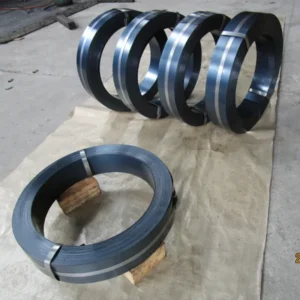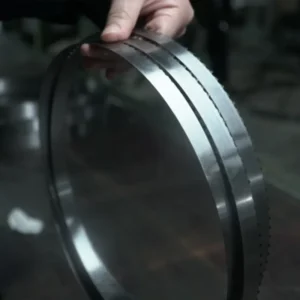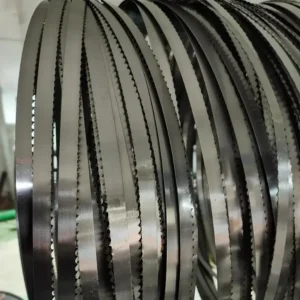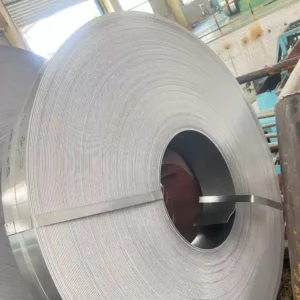
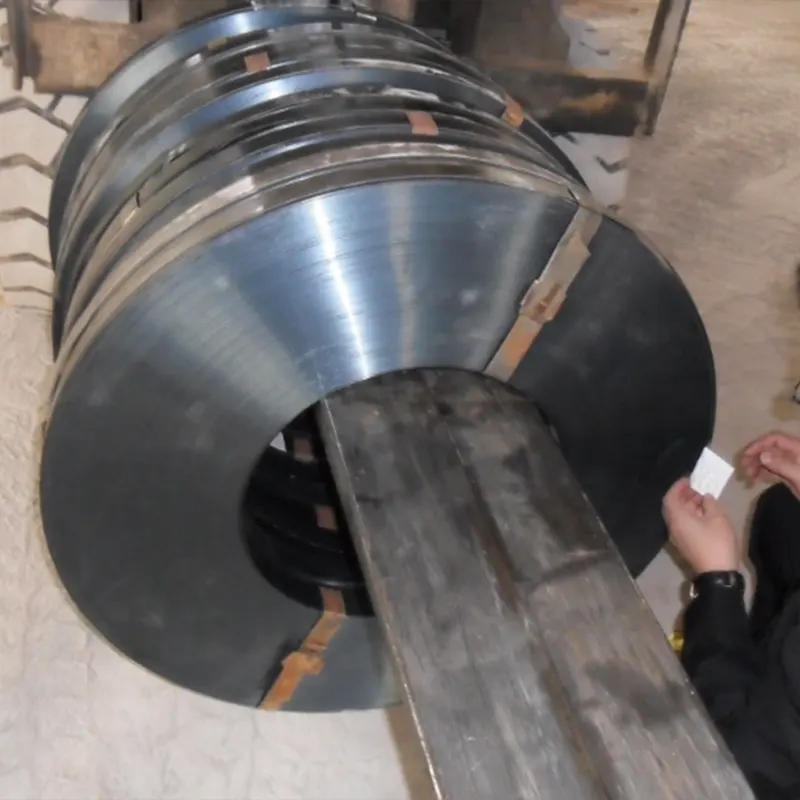
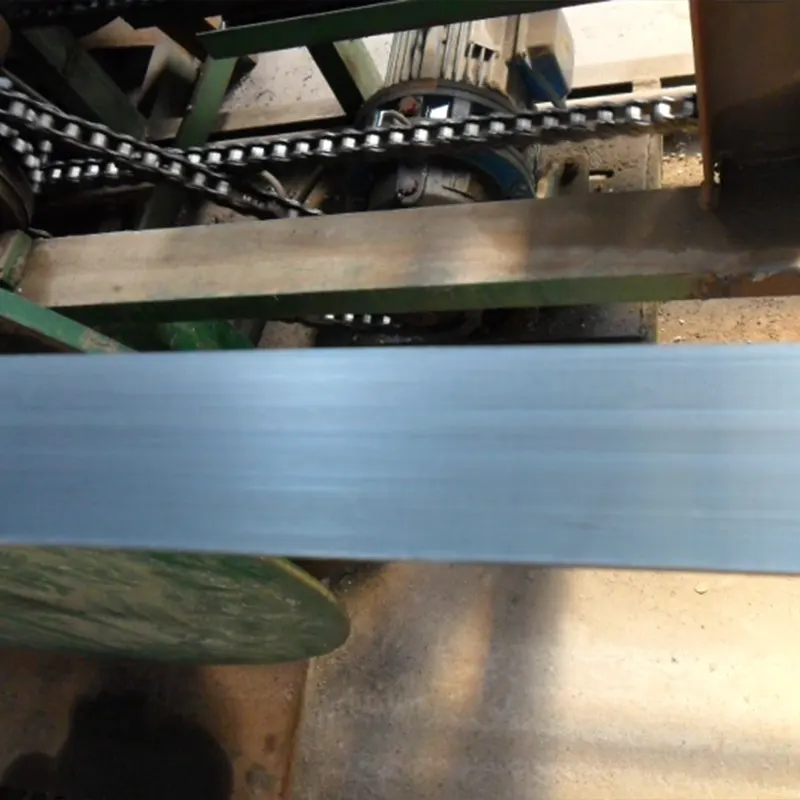
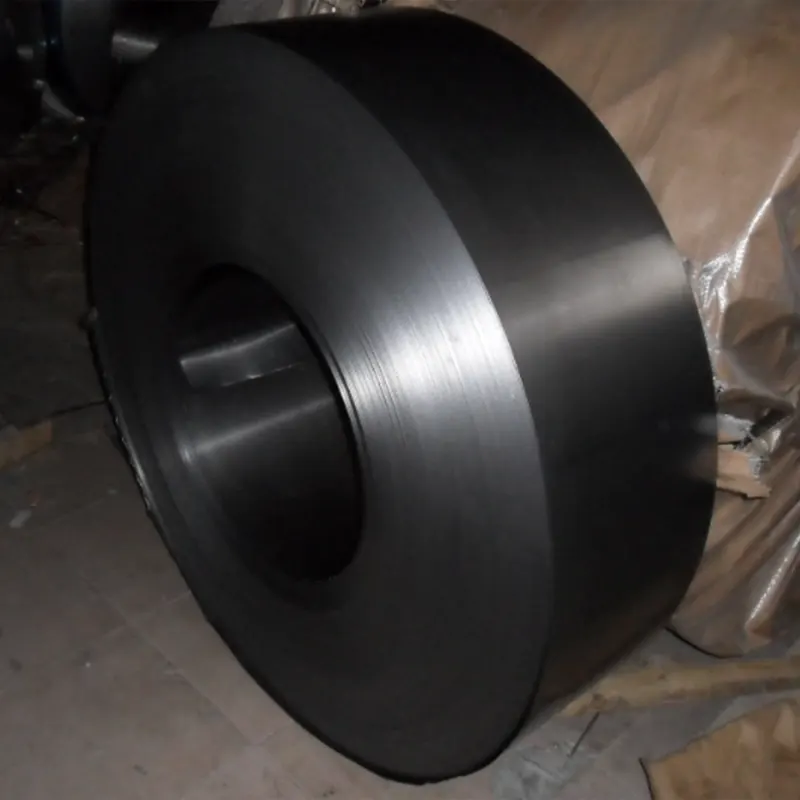
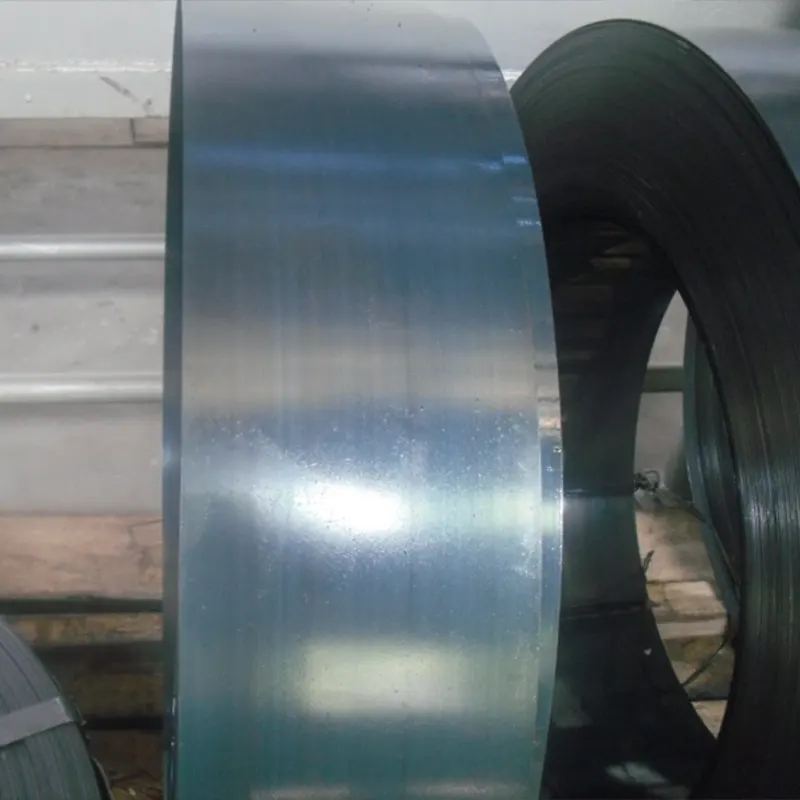
Quick Specifications
| Artículo | Parámetro |
|---|---|
| Core grades | 51CrV4 (1.8159 / AISI 6150 / SUP10), 75Nosotros8 (1.5634), C75Cr1 (1.2003) |
| Thickness range (rolado) | 0.05 – 6.0 milímetros |
| Width range | 5 – 600 milímetros (slit to ±0.05 mm tolerance) |
| Condición de entrega | recocido / Cold-rolled / Apagado & templado |
| Hardness range | Annealed ≤ 190 alto voltaje (75Nosotros8); Q&T HRC 40 – 55; 51CrV4/6150 cold-rolled annealed HRB 80 – 90 |
| Superficie | Mill finish / pickled / oiled, personalizable |
| Cantidad mínima de pedido | 100 kilos (narrow strip) / 500 kilos (standard width) |
| Lead time | 15 – 30 days from stock; 25 – 40 days for custom production |
What Each Grade Solves
Selecting a grade is not about picking “the strongest one.” It is about picking the one whose springback and fatigue life are most predictable under your part geometry and heat-treatment path.
51CrV4 / 6150 (Cr-V alloy system) — The default base grade for elastic clips, sujetadores, and clutch diaphragm springs. Vanadium addition refines grain size and lowers overheating sensitivity, delivering tensile strength ≥ 1274 MPa and yield strength ≥ 1127 MPa after quenching and tempering, while retaining sufficient ductility and toughness. 51CrV4 and 6150 can be treated as equivalent grades in most cold-rolled strip applications, suitable for parts that undergo deformation quenching or final heat treatment after stamping. Annealed cold-rolled hardness is controlled at HRB 80 – 90, with spheroidization rate consistently above 90%, providing a repeatable deformation-resistance baseline for downstream stamping. Service temperature limit: 300 °C, covering the majority of engine-bay and chassis elastic components.
75Nosotros8 (Ni alloy system) — When a part’s sensitivity to springback consistency outranks its demand for ultimate strength, 75Ni8 is the better answer. Con 1.8 – 2.1% En, it reaches 1200 – 1800 MPa tensile strength in the Q&T condition, while nickel in solid solution preserves plastic reserve across a wide hardness window. Suited to precision-stamped elastic clips and retainers with narrow springback windows, and to thin-gauge parts that must balance formability with final elasticity.
C75Cr1 (high-carbon Cr micro-alloyed system) — With 0.70 – 0.80% C and approximately 0.40 – 0.60% cr, this grade targets high-hardness, wear-resistant elastic parts where cost sensitivity matters. Q&T hardness reaches 43 – 49 CDH, suitable for fasteners and retainers with high elastic recovery demand but relatively simple geometry and a mature heat-treatment route. Compared with 75Ni8, C75Cr1 responds more directly to hardness in heat treatment, but demands tighter control of the tempering window.
How to Select Spring Steel Strip for Automotive Components
Paso 1: Define the thickness–width–edge-quality envelope from part geometry
Elastic clips, sujetadores, and retainers share a common structural profile: thin wall, narrow width, multiple bends, high-speed stamping in progressive dies. This means strip thickness tolerance and edge quality feed directly into the springback equation. A 0.01 mm thickness variation on a long bend arm can amplify into an unacceptable springback deviation. Width-direction hardness non-uniformity causes systematic drift in forming angle at different positions within the same coil.
Decision criterion: For clip-type parts with bend radius ≤ 1.5t, specify precision cold-rolled narrow strip with width tolerance within ±0.05 mm, and require the supplier to provide transverse hardness distribution data, not just an “average.” If part width exceeds 300 mm and requires slitting, confirm that edge burr height and the edge work-hardened layer after slitting are included in outgoing inspection.
Paso 2: Define delivery condition from the process route
The stamping–forming–heat-treatment sequence determines whether you should buy annealed or quenched-and-tempered.
If your plant has full quench-and-temper capability and parts require deformation quenching or final heat treatment after forming to develop elasticity: purchase annealed or spheroidize-annealed. Annealed hardness is lowest (75Ni8 annealed ≈ 210 alto voltaje; 51CrV4 cold-rolled annealed HRB 80 – 90), giving low springback and controllable die wear during stamping, with final mechanical properties established by heat treatment afterward. Spheroidized microstructure also promotes more uniform austenitization during subsequent quench heating, helping reduce batch-to-batch heat-treatment response variation.
If parts receive no heat treatment after stamping and elasticity comes directly from the incoming material: purchase quenched-and-tempered. Q&T spring steel strip in the HRC 40 – 55 range can go directly into spring production, eliminating the heat-treatment step — at the cost of significantly higher stamping springback, which requires die compensation designed against the measured elastic modulus and yield behavior at that hardness.
A common misjudgment: choosing a harder delivery condition “for safety,” then seeing cracking rates rise during stamping, then compensating through die clearance adjustments that introduce even greater springback scatter. The selection criterion for delivery condition is not “how hard the final part must be,” but “at which process step hardness should be established.”
Paso 3: Work backward from target hardness to grade and heat-treatment route
Hardness requirements should be decomposed into two variables: the elastic recovery the part needs in service, y the forming difficulty acceptable in manufacturing.
-
CDH 40 – 48: Both 51CrV4 / 6150 and 75Ni8 cover this range. Prefer 51CrV4 if a subsequent quenching step exists and higher yield strength is needed; prefer 75Ni8 if springback consistency and forming ductility are more critical.
-
CDH 48 – 55: C75Cr1 or high-hardness Q&T 75Ni8. Simultaneously confirm whether the stamping die can withstand the springback force and edge-cracking risk at this hardness.
-
recocido, formed, then heat-treated in-house: Use annealed hardness as the baseline for the stamping process window, and grade selection as the basis for target hardness after quenching and tempering. The hardness level corresponding to 51CrV4/6150’s ≥ 1274 MPa tensile strength after Q&T is the starting point for judging whether that grade meets the part’s elastic requirements.
Paso 4: Lock “batch consistency” clauses into heat-treatment requirements
“Unstable performance after heat treatment” on the procurement side usually does not originate in the furnace itself. It originates in incoming-material variation within the compositional adjustment window, amplified downstream. 51CrV4: C 0.47 – 0.55%, cr 0.90 – 1.20%, V 0.10 – 0.25%. 75Nosotros8: En 1.8 – 2.1%. C75Cr1: cr 0.40 – 0.60%. If a supplier can provide measured chemical composition per heat lot rather than a blanket “meets standard” declaration, you have obtained the first traceable variable for predicting quench hardness response.
A further criterion: require spheroidization rate or microstructure rating data with each lot. A spheroidization rate ≥ 90% in 51CrV4 cold-rolled annealed strip is the accepted threshold for automotive clutch diaphragm spring applications, and carries equal reference value for elastic clips and fasteners — incompletely spheroidized microstructure dissolves non-uniformly during quench heating, manifesting directly as wider hardness scatter after tempering.
Why Batch Variation Is the Most Expensive Hidden Cost in Elastic Component Manufacturing
Springback variation and unstable post-heat-treatment performance never appear on a financial statement as “a material problem.” They appear as: increased die debugging hours, lower first-piece yield, higher elastic sorting rates within a lot, and warranty claims from inconsistent clamping force at the customer’s assembly line.
The metallurgical design of these four grades is not difficult to make “compliant.” What is difficult is making this coil and the next coil exhibit the same deformation resistance. This product page therefore lists batch consistency as a core procurement metric alongside chemical composition and hardness — not as an added service commitment. Available lot-traceability documentation includes: measured chemical composition per heat number, annealed hardness and spheroidization rate, Q&T hardness distribution (where applicable), and transverse thickness and hardness profile data.
FAQ
Q: Can 51CrV4 and 6150 be used interchangeably?
In cold-rolled spring steel strip applications, the two are closely matched in compositional system and mechanical property targets (51CrV4 corresponds to DIN 1.8159 / AISI 6150 / JIS SUP10) and can generally be treated as equivalent grades. Interchange should be confirmed against the supplier’s measured composition and hardness data — not on grade name alone.
Q: Can annealed strip deliver elasticity directly after stamping without heat treatment?
No. Annealed microstructure consists primarily of ferrite plus spheroidized carbides — low hardness, good ductility, designed for forming. Elasticity comes from the martensitic / tempered martensitic structure established by subsequent quenching and tempering. If part design does not permit post-stamping heat treatment, purchase quenched-and-tempered strip directly.
Q: 75Ni8 costs more than 51CrV4. When is it worth specifying?
When the part’s springback window is extremely narrow, or when stable elastic performance must be maintained after stamping without final heat treatment, 75Ni8’s nickel alloy system provides a wider formability–elasticity compatibility range. Its value is not higher ultimate strength, but more predictable batch-to-batch springback behavior.
Q: How can I judge whether a supplier’s “batch consistency” claim is credible?
Request measured annealed hardness and spheroidization rate data across 3 – 5 consecutive heat lots, and examine the range — not just the average. If the supplier can only provide the standard range from a mill certificate and cannot supply per-lot measured distributions, batch consistency remains a claim rather than a fact.