1. Why 420J2 Hardened Steel Strip Is Included in the Wear-Part Candidate Set—and When It Should Be Excluded
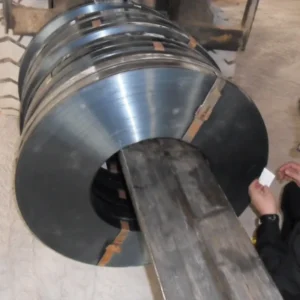
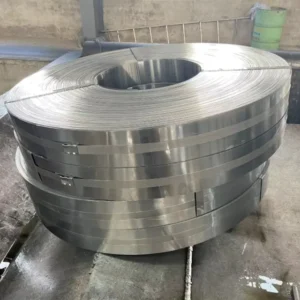
In precision wear-part material selection, hardness is the most visible entry indicator, but it is not the only deciding factor. The value of 420J2 lies in this: it provides a hardness–cost–corrosion-resistance balance point in the martensitic stainless steel system between standard 420 stainless steel and high-carbon 440C. Después de enfriar y templar, a hardness of 52–56 HRC is sufficient for many sliding-friction, mild abrasive-wear, and edge-retention applications. In the cold-rolled full-hard condition, the strip is supplied at 280–320 HV and 880–1030 N/mm² tensile strength, making it suitable for thin-strip parts that will not be quenched after forming and rely on work hardening to maintain wear resistance.
This candidate status has clear boundaries, however. If the dominant wear mechanism is electrochemical corrosion in a strongly corrosive medium, 420J2 should be excluded; if the part requires welding or deep cold forming in the hardened condition, 420J2 is usually not a reasonable choice; and if the wear-life target requires 440C-class hardness (58–60 HRC or above), the hardness ceiling of 420J2 is not a match. The core function of this page is to help the selector make judgments at these boundaries, not to recommend the grade indiscriminately.
2. Key Specifications: Dureza, Calidad de la superficie, and Dimensional Accuracy
The data below are separated by supply condition. The “hardness” of 420J2 is not a single number; the final hardening path of the part must first be confirmed: whether the strip will be used directly in the cold-rolled hard condition, or whether the mill or part manufacturer will complete quenching and tempering before use.
2.1 Hardness and Strength
| Supply / condition | Dureza | Resistencia a la tracción | Application logic |
|---|---|---|---|
| Cold-rolled full hard (as-rolled full hard) | 280–320 HV (aprox. 28–32 HRC) | 880–1030 N/mm² | Precision stamped thin-strip parts; no post-forming heat treatment; hardness from cold work hardening |
| Apagado + low-temperature tempered | 52–56 HRC | ≥ 860 MPa (where specified by applicable standards) | Wear plates and edge-type parts required to be blanked or used directly in the hardened condition |
| Annealed soft condition (for subsequent forming + customer hardening) | 150–200 HV | 540–655 N/mm² | Process route for complex shapes: form first, harden afterward |
2.2 Calidad de la superficie
The surface condition of precision steel strip directly affects friction coefficient, tool life, and fatigue performance. Surface grades available for 420J2 hardened strip include:
-
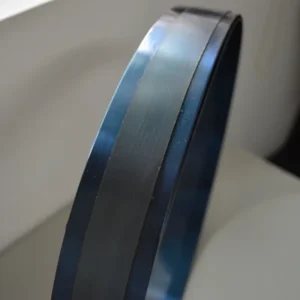
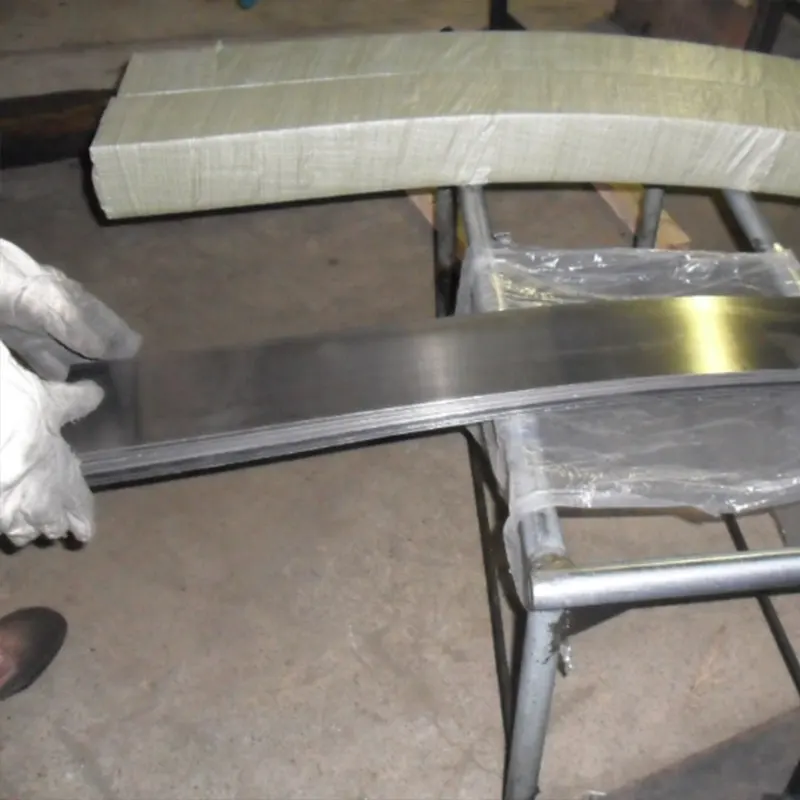
Bright annealed / bright hardened: bright surface, suitable for most precision stamped and sliding-contact parts.
-
Bright polished: surface roughness can reach the Ra < 6 µin (aproximadamente 0.15 µm) level, suitable for components with requirements on friction noise, sealing fit, or appearance.
-
2B / BA cold-rolled surface: suitable for general wear-resistant gaskets, lavadoras, and similar parts.
For fatigue-sensitive or sliding-contact parts, additional attention should be paid to decarburization y edge burrs. Precision strip is typically required to be free of decarburization, with slit-deburred edges. If the part experiences cyclic loading in service, surface scratches and edge microcracks can become fatigue crack initiation sites; allowable defect depth should be specified separately in the purchase specification.
2.3 Dimensional Accuracy
The thickness tolerance and strip shape of hardened precision strip are key variables determining continuous-stamping stability. The following order of magnitude can be used for specification discussions:
| Parámetro | Typical precision level | Remarks |
|---|---|---|
| Thickness range | 0.02–3.5 mm (common supply range for cold-rolled hard strip) | Upper limit depends on rolling and slitting capability |
| Tolerancia de grosor | ± 0.01 mm (standard precision) to within ±0.025 mm | May reference Swedish tolerance table T2 class or equivalent internal standard |
| Tolerancia de ancho | On the order of ±0.05 mm | Slitting accuracy affects feed alignment |
| Strip shape (llanura) | On the order of 0.2% of strip width / or as agreed per PIW | Particularly critical for high-speed stamping and automatic feeding |
Thickness-tolerance data reference industrial practice for precision cold-rolled strip: tolerances on the order of ±0.01 mm are achievable in the 0.15–2.8 mm thickness range, with tighter tolerances or ±0.025 mm classes available depending on thickness/width combination. Flatness control references precision strip standards. Committable tolerances must be confirmed against mill grade capability and the ordered thickness/width combination; this page does not replace the tolerance agreement in a specific quotation.
3. Application Fit Assessment: Which Automotive Parts May Fit—and Which Should Be Excluded
Reasonable candidate applications for 420J2 hardened steel strip are not “all wear parts” but precision small components in which the wear mechanism is primarily sliding friction, mild abrasive wear, or edge retention, and the corrosive environment is not severe. The following reference list is organized by fit logic; selection can be confirmed only after three part-level checks: hardness requirement, corrosion exposure level, and forming process.
3.1 Candidate scenarios for detailed evaluation
-
Seatbelt retractor springs / tensioning components: These use the high strength and elasticity of the hardened condition, but it must be confirmed whether spring forming is done in the annealed condition or by direct coiling in full hard. In full hard, springback is significant; complex spring shapes usually require annealed forming + subsequent hardening.
-
Small wear-resistant washers, spacers, and clutch rings in brake systems: Under sliding contact or mild friction, the 52–56 HRC Q&T condition of 420J2 can provide useful wear life, but contact stress levels should be verified against the material’s load-bearing capacity.
-
Sensor signal rings / magnetic trigger rings: 420J2 has a strongly magnetic martensitic structure and can be used for wear-resistant ring parts requiring magnetic signal response, but the service temperature must not exceed the tempering temperature to avoid loss of hardness and magnetic performance.
-
Precision sliding components for pumps and valves (non-highly corrosive media): Such as hydraulic valve spools and wear-resistant bushings in mildly corrosive media, provided the corrosion level of the medium is within the tolerance range of 420J2.
3.2 Scenarios in which 420J2 should not be the first choice, or requires strict limits
-
Wear parts in strongly corrosive environments (salt spray, acidic condensate, long-term humid chloride-containing media): 12%–14% Cr in 420J2 provides only moderate corrosion resistance; although the hardened condition is more corrosion-resistant than the annealed condition, it is far from a substitute for 304/316 or duplex stainless steel. When “wear resistance + corrosion resistance” are both primary constraints, higher-Cr/Ni alternatives should be evaluated first, or surface protection should be used.
-
Components requiring welding in the hardened condition: 420J2 has poor weldability; welding in the hardened condition is prone to cold cracking and requires immediate post-weld heat treatment, but many precision-part process chains do not allow post-weld heat treatment. Welded joints should be replaced by mechanical joints (riveting, bolting, interference fit).
-
Parts requiring deep cold forming in the hardened condition: At 52–56 HRC, strip causes high tool wear during blanking, flexión, and flanging; springback is difficult to control and edge-cracking risk increases. If part geometry requires significant forming, use annealed forming + subsequent Q&t, or evaluate a lower-hardness hardened strip.
-
High-load abrasive wear requiring 440C-class wear life: 440C at 58–60 HRC offers higher wear resistance than 420J2, at the cost of lower corrosion resistance and higher cost. When the hardness ceiling of 420J2 is insufficient for the target wear rate, move directly to evaluation of 440C or powder-metallurgy high-alloy systems, rather than chasing extreme hardness by raising the austenitizing temperature of 420J2 before tempering.
4. Application Limits: Constraints That Must Be Written into the Technical Agreement
420J2 hardened steel strip is an engineering variable that must be explicitly managed in the design of precision parts.
Corrosion-resistance class. In the hardened condition, 420J2 has some resistance to atmosphere, fresh water, mild alkalis, and weak acids, but it is not suitable for strong acids, chloride solutions, or long-term humid corrosive environments. If the part contacts cutting fluids, cleaning agents, or road de-icing salt in service, the actual medium and exposure cycle should be provided for a corrosion-class assessment; if necessary, enchapado, revestimiento, or a more corrosion-resistant grade should be selected.
Welding restriction. Welding is not recommended in the annealed or hardened-and-tempered condition. The welding thermal cycle forms untempered martensite in the heat-affected zone, significantly increasing cold-cracking susceptibility. Part design should prioritize mechanical fastening or adhesive bonding; if welding is unavoidable, immediate post-weld heat treatment must be included in the process chain, and hardness and dimensions must be re-verified.
Springback and forming window. Hardened strip has high yield strength, and elastic recovery after bending and blanking is greater than that of low-carbon steel. In continuous stamping, springback compensation must be designed into the tool; complex forming of full-hard thin strip may require intermediate annealing, which sacrifices some of the strength from work hardening. Forming feasibility should be verified with actual tool trials at the prototype stage; material data sheets are not a substitute.
Notch sensitivity and fatigue. High-hardness martensitic structures are sensitive to surface notches, edge burrs, and decarburized layers. For parts under cyclic loading (muelles, reciprocating sliding parts), allowable surface-defect limits and edge condition should be specified in the purchase specification, and sharp notches should be avoided in part design.
Maximum service temperature. The tempering temperature of 420J2 determines its maximum service temperature. Q&T parts should not operate long-term at temperatures above the final tempering temperature; otherwise hardness and strength will decrease. If the part service temperature approaches or exceeds 200°C, the tempering schedule should be re-evaluated or the grade changed.
5. Positioning vs. Common Alternative Grades
| Dimensión | 420J2 hardened strip | 440C | 301 stainless strip (curtido) |
|---|---|---|---|
| Hardening mechanism | Martensitic transformation (Q&t) or cold work hardening | Martensitic transformation | Work hardening (austenite → martensite) |
| Typical hardness ceiling | 52–56 HRC (Q&t); full hard approx. 28–32 HRC | 58–60 HRC | Depends on cold-rolling reduction; can be high, but the wear mechanism differs |
| Wear-resistance positioning | Medium-high; moderate edge retention | Alto; suitable for high-load abrasive wear and sliding contact | Primarily strength, fatigue, and elasticity; wear resistance is not the primary advantage |
| Corrosion resistance | Moderado; hardened condition is better than annealed, but not suitable for severe corrosion | Lower than 420J2 (higher carbon reduces corrosion resistance) | Better than 420J2 (austenitic matrix, high chromium) |
| Formabilidad | Limited in the hardened condition; significant springback; complex forming requires the annealed route | Harder; more difficult to form | Excelente; suitable for complex forming and spring coiling |
| Soldabilidad | Poor; hardened-condition welding is prone to cold cracking | Poor | Fairly good |
| Cost and availability | Economical; mature precision strip supply | Higher; relatively narrower supply channels | Widely available; competitive cost |
Comparison data are synthesized from the hardness–corrosion trade-off between 420J2 and 440C; the formability and work-hardening characteristics of 301; and the multi-variable logic of hardness, tenacidad, springback, and fatigue in precision strip selection.
Selection-criteria summary: If the part needs a balance among medium-high wear resistance, moderate corrosion resistance, and economically available precision strip, 420J2 is a reasonable candidate. If wear resistance outweighs corrosion resistance, move to 440C evaluation. If forming complexity or corrosion resistance is the higher priority and the hardness requirement can be met within the work-hardening range, 301 is a more natural starting point. 420J2 should not be used as a “default wear-resistant strip”; it is the grade that remains a fit after elimination.
6. Clauses Recommended for Purchase and Technical Agreements
Based on the above limits, when requesting quotations for 420J2 hardened strip, the following parameters should be written into the technical agreement rather than relying only on the grade name:
-
Supply condition: cold-rolled full hard / Q&t / recocido, with hardness test standard (HV or HRC) and sampling location.
-
Hardness range: for Q&t, agree on an acceptance range of 52–56 HRC and allowed variation; for full hard, specify an HV range rather than merely “full hard.”
-
Thickness tolerance class: specify standard precision or high precision, and whether Swedish tolerance table T2 or an equivalent standard applies.
-
Surface roughness: specify maximum Ra (p.ej., Ra ≤ 0.4 µm or as required by part function) and allowable surface defect types (scratches, roll marks, decarburization).
-
Edge condition: slit-deburred / round edge / square edge, and maximum burr height.
-
Strip shape: quantitative limits for flatness or camber, and measurement method for coil or cut-to-length delivery.
-
Corrosion and heat-treatment restrictions: if the part involves welding or service temperature close to the tempering temperature, this should be flagged to the supplier so that the heat-treatment schedule can be adapted or a service-boundary statement provided.
7. FAQ
Q1: Does “hard” in 420J2 hardened steel strip mean quenched or cold-work-hardened?
Both may be referred to simply as “hard,” but they mean different things. Cold-rolled full hard derives hardness from rolling work hardening, typically 280–320 HV and 880–1030 N/mm² tensile strength, and is suitable for precision thin-strip parts that will not be heat-treated after forming. The Q&T condition obtains a martensitic structure by austenitizing, temple, and low-temperature tempering; hardness can reach 52–56 HRC, wear resistance is significantly higher, but the forming window is narrower. Quotations and technical agreements must specify which condition is required; “hard” alone is insufficient.
Q2: Is the wear resistance of 420J2 sufficient to replace 440C?
Under medium-load sliding friction and mild abrasive wear, the 52–56 HRC Q&T condition of 420J2 can provide usable wear life, with better corrosion resistance and lower cost than 440C. In high-load abrasive wear, repeated sliding contact, or applications requiring longer maintenance intervals, however, the wear advantage of 440C at 58–60 HRC cannot be fully offset by process adjustments to 420J2. This is not a “good versus bad” question; it is a fit question determined by wear mechanism and life target.
Q3: Can 420J2 hardened steel strip be welded?
Conventional welding in the hardened or annealed condition is not recommended. The heat-affected zone forms brittle untempered martensite, and cold cracking is likely under shrinkage stress. Precision wear parts should prioritize mechanical fastening (riveting, bolting, interference fit) or adhesive bonding. If the structure makes welding unavoidable, immediate post-weld heat treatment is a required operation, and hardness and dimensional stability must be re-verified; many precision strip-part process chains do not allow this additional heat treatment, so welding should be treated as an exclusionary constraint at the material-selection stage.
Q4: Can full-hard 420J2 strip be used for complex-shape stamping?
The 280–320 HV hardness of full hard is lower than that of the Q&T condition but still significantly higher than the annealed soft condition. Simple bending, blanking, and shallow drawing are feasible with proper tool design and springback compensation; complex three-dimensional forming, small-radius bending, or flanging is prone to cracking and excessive springback. If part geometry is complex, the more robust route is annealed strip → forming → Q&T → sizing, rather than forcing all forming operations in the full-hard condition.
Q5: Is the corrosion resistance of 420J2 hardened strip sufficient for automotive underbody or engine-bay applications?
This depends on the specific corrosion exposure level. Hardened 420J2 has some resistance to atmosphere, fresh water, and mild media, but 12%–14% Cr is not sufficient to provide 304/316-level protection in salt spray, de-icing salt, acidic condensate, or long-term humid environments. For engine-bay interiors, dry oil-medium environments, or protected interior parts, the corrosion level of 420J2 may be sufficient; for underbody parts directly exposed to road salt spray or wet brake-dust deposits, part-level corrosion validation or a more corrosion-resistant grade/surface protection should be selected. “Stainless steel” should not be equated with “rust-free” to pass a selection review.