1. Specification Matrix: Width × Thickness × Recommended Pitch
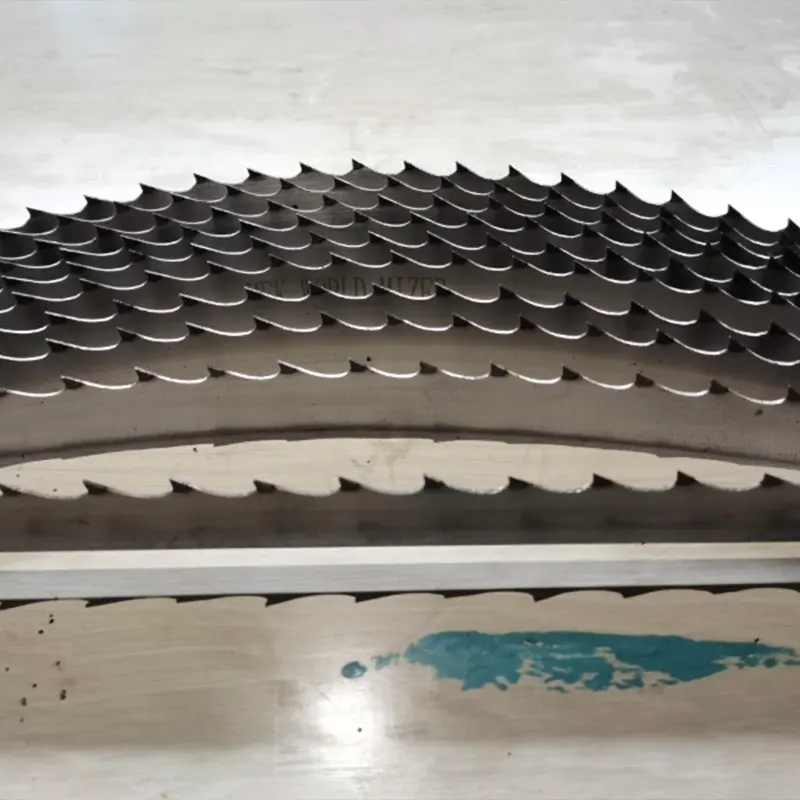
The pitch column gives the recommended variable-pitch range for that width/thickness combination, not the full manufacturable range. Actual available pitch can extend from 2/3 к 10/14 TPI.
| Width × Thickness (мм) | Recommended Variable Pitch (TPI) | Typical Workpiece Fit | Machine Positioning |
|---|---|---|---|
| 0.65 × 13 | 10/14 или 8/12 | Small solid bar, thin-wall small tube, bundled small stock | Small horizontal / portable saw |
| 0.9 × 16 | 8/12 или 6/10 | Small-to-medium solid bar, thin-to-medium wall tube | Small-to-medium horizontal saw |
| 0.9 × 19 | 6/10 или 5/8 | Medium solid bar, medium tube, small profiles | General horizontal saw |
| 0.9 × 27 | 5/8 или 4/6 | Medium-to-large solid bar, medium profiles, heavy-wall tube | Общий / medium-large horizontal saw |
| 1.1 × 34 | 4/6 или 3/4 | Large solid bar, medium-to-large profiles, heavy-wall tube | Medium-large / automatic saw |
| 1.3 × 41 | 3/4 или 2/3 | Large-section solid bar, heavy profiles, heavy-wall tube | Large / automatic saw |
| 1.6 × 54 / 67 / 80 | 2/3 или 1.4/2 | Extra-large solid stock, large forgings, thick plate | Heavy-duty horizontal / vertical saw |
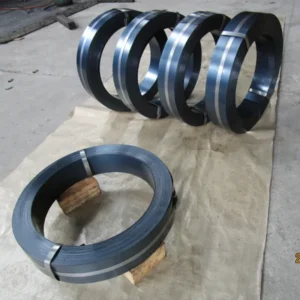
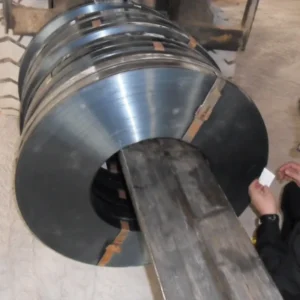
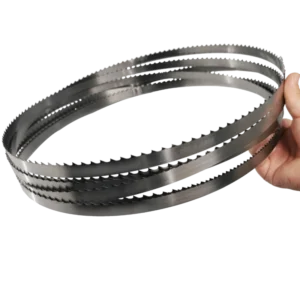
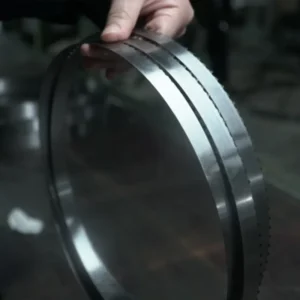
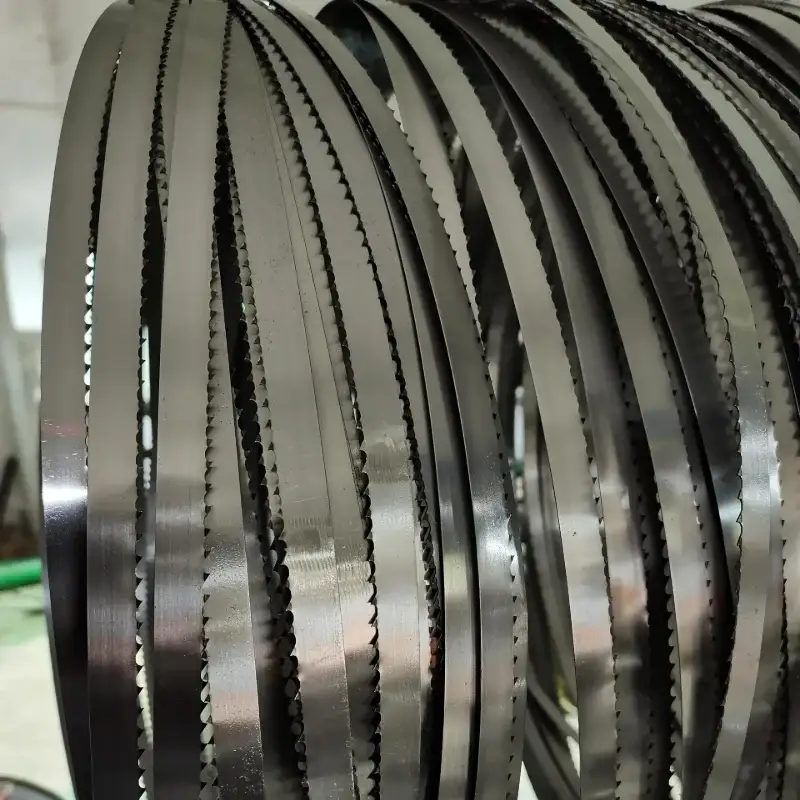
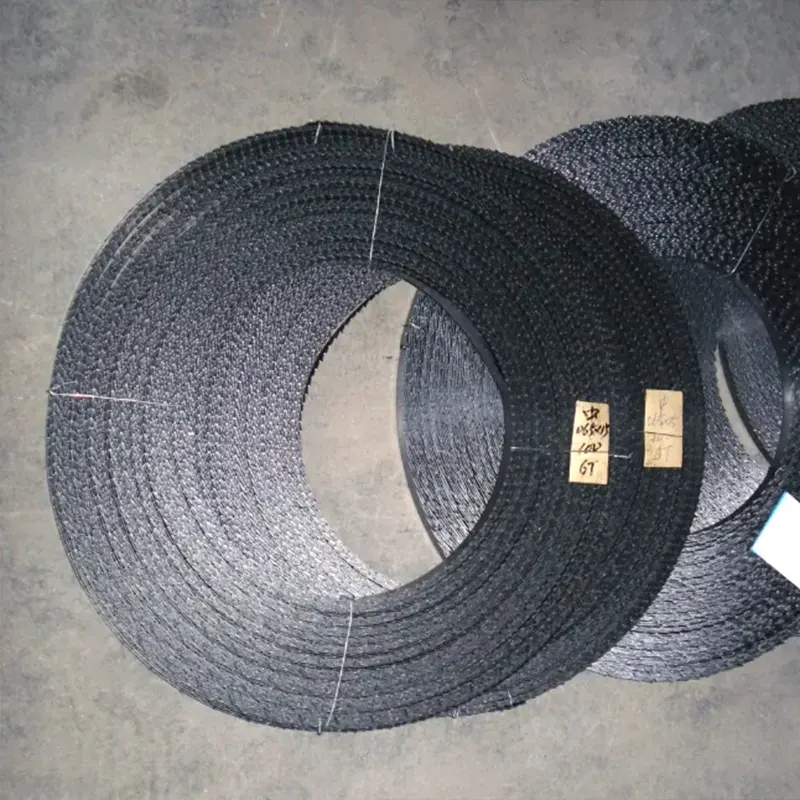
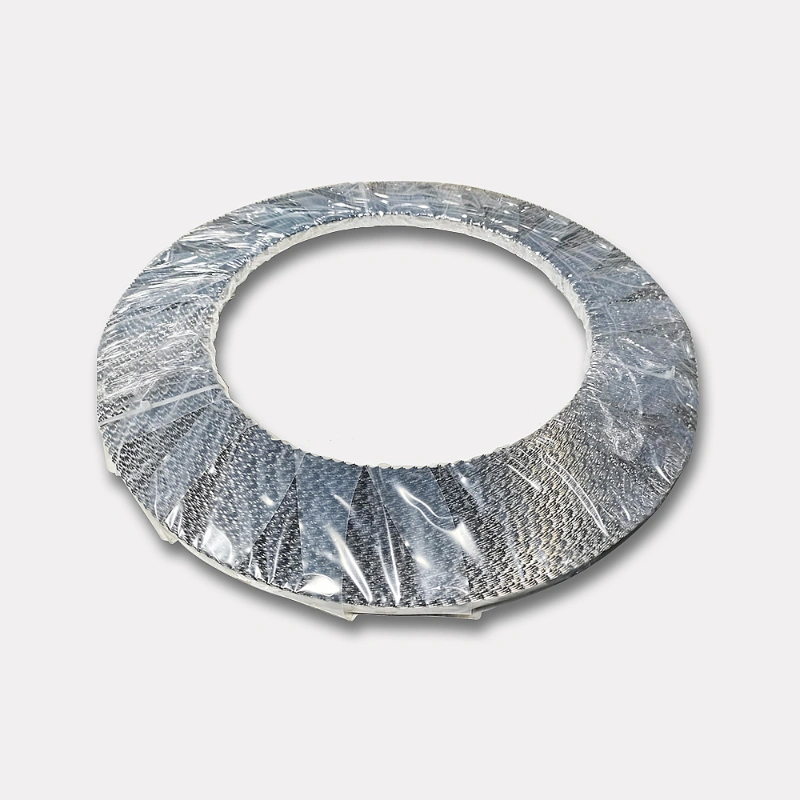
Supply forms: M42 blades are available as welded loop (cut to the machine’s center-to-center length) и coil / roll stock (welded in-house by the customer). Welded loops arrive with the butt weld completed and are ready to install. Coil suits shops with their own blade welding equipment that want to cut different lengths for multiple machines. Standard coil lengths are available in 50 m / 100 m / 150 m; welded loop lengths are customized to the customer’s machine specification.
2. Pitch Selection: Choose by Teeth-in-Cut, Not by Rule of Thumb
There is only one engineering criterion for pitch selection: 3–6 teeth should be in the cut at any moment. Below 3 teeth, impact load per tooth is too high and tooth stripping becomes likely; above 6 teeth, chip clearance volume is insufficient, chips cannot evacuate, and overheating and blade drift follow. From there, split into two paths by workpiece form:
Solid Steel Bar — Select Pitch by Diameter
| Bar Diameter / Ширина | Recommended Variable Pitch (TPI) |
|---|---|
| ≤ 25 мм | 10/14 |
| 25–50 mm | 6/10 или 5/8 |
| 50–80 mm | 5/8 или 4/6 |
| 80–120 mm | 4/6 или 3/4 |
| 120–200 mm | 3/4 или 2/3 |
| 200–400 mm | 2/3 или 1.4/2 |
Standard pitch selection ranges for bimetal band saw blades.
Steel Tube and Profiles — Select Pitch by Wall Thickness, Not Outside Diameter
This is where tube and profile cutting most often goes wrong. The effective cutting thickness of thin-wall tube is the wall thickness, not the OD. Once the pitch exceeds twice the wall thickness, tooth hooking and tooth stripping occur.
| Wall Thickness | Recommended Variable Pitch (TPI) |
|---|---|
| < 2 мм | 14/18 или 10/14 |
| 2–3 mm | 10/14 |
| 3–5 mm | 8/12 или 6/10 |
| 5–8 mm | 6/10 или 5/8 |
| 8–12 mm | 5/8 или 4/6 |
| > 12 мм | 4/6 или 3/4 |
Tube/profile wall-thickness-to-pitch correspondence table.
Bundled cutting note: When multiple tubes or profiles are clamped and cut as a bundle, select pitch by the total section thickness of the bundle, not the wall thickness of a single piece. Otherwise the pitch will be too fine and the chip gullets will fill quickly.
3. Where M42 Sits in the RÖNTGEN Bimetal Hierarchy: Relationship to Master Supreme (M51)
The RÖNTGEN Master Supreme uses an HSS M51 tooth tip with roughly 10% Co and 69–70 HRC tooth hardness, capable of cutting materials up to 50 СПЧ (1600 N/mm²). Its design centers on a 16° high rake angle and large-section chip evacuation geometry, targeting high-alloy steel, large forgings, Inconel/Hastelloy/Duplex and similar difficult materials. M51 is the higher tooth-material grade above M42, aimed at jobs where “M42 life is not enough.”
M42’s irreplaceability is not in being harder, but in being correctly matched:
| Dimension | M42 Bimetal | Master Supreme (M51) |
|---|---|---|
| Tooth hardness | 68–69 HRC | 69–70 HRC |
| Co content | 8% | 10% |
| Economical machinable hardness ceiling | ~45 HRC | 50 СПЧ (1600 N/mm²) |
| Optimal section range | Small-medium to medium-large | Large to extra-large |
| Core workpieces | Углеродистая сталь, легированная сталь, stainless bar/tube/profile | High-alloy steel, large forgings, nickel-based alloys, duplex |
| Supply form | Welded loop / coil | Primarily welded loop |
| Purchasing logic | General baseline, batch coverage | Problem-specific upgrade |
Decision rule for shops: If incoming stock is mainly углеродистая сталь / alloy steel bar, tube, and profiles with hardness consistently below 45 СПЧ, M42 is the better total-cost-of-ownership choice — lower tooth-material cost than M51, while the 68–69 HRC tooth tip already provides sufficient wear life on standard steel grades. Only when workpieces move into the 50 HRC range, large-section high-alloy forgings, or nickel-based/duplex stainless is it time to step up to Master Supreme’s M51 tooth material.
4. Five Specification Fields to Confirm Before Ordering
These five fields are the ones most often distorted by verbal descriptions. Confirm each in writing:
-
Machine center-to-center distance (welded loop length): Welded loops are cut to the center distance of the two wheels. The same width/thickness spec is not interchangeable across different machines.
-
Exact width × thickness combination: Например, 34 × 1.1 и 34 × 1.3 differ in rigidity and chip capacity and are not substitutes.
-
Pitch code: Write “4/6 TPI,” not “medium tooth.” The variable-pitch code (например, 4/6, 5/8) is itself part of the specification.
-
Tooth form / rake angle: The standard M42 rake differs from the 16° high rake of M51 Master Supreme. Carrying tooth-form parameters across tooth-material grades creates a cutting-force mismatch.
-
Supply form: Welded loops are ready to run; coil requires confirmation of in-house blade welding capability and coil packaging (rust-inhibiting paper plus plastic film is a common configuration).
5. Часто задаваемые вопросы
Q1: Can M42 bimetal band saw blades cut stainless steel?
Да. M42 is the general starting point for stainless steel among bimetal band saw blades. The 8% Co tooth material balances hot hardness and wear resistance well, suiting batch cutting of most stainless bar, tube, and profiles. If the workpiece is large-section or high-alloy stainless and M42 life is clearly insufficient, step up to the M51 grade.
Q2: What pitch should I use for a 50 mm solid steel bar with M42?
Start with 5/8 или 4/6 TPI variable pitch. That range keeps roughly 4–6 teeth in the cut on a 50 mm section, balancing chip evacuation and tooth load.
Q3: Why can’t I use 4/6 TPI on 2 mm wall thickness steel tube?
А 4/6 TPI pitch is larger than twice the 2 mm wall thickness. The teeth will “bridge over” the wall, causing tooth hooking, tooth stripping, or wall tearing. Thin-wall tube requires a fine variable pitch such as 10/14 или 14/18 TPI to ensure enough teeth land within the wall thickness.
Q4: What is the essential difference between M42 and M51? Is M51 universally better than M42?
Нет. M51’s advantage is the higher hot hardness and wear resistance from higher Co content, which lets it enter the 50 HRC range and large-section difficult materials. But in small-to-medium section cutting of standard carbon/alloy bar, tube, and profiles, M42’s 68–69 HRC tooth tip already covers the vast majority of jobs at lower unit cost. The selection logic is “grade by workpiece hardness and section,” not “always pick the highest grade.”
Q5: How do I choose between welded loop and coil?
Welded loop: Install on arrival; suits standard machines and shops that do not want to weld in-house. Length is customized to machine center distance, so a machine change requires a new length. Катушка: Suits shops with blade welding equipment and multiple machines of different lengths needing flexible cutting; higher inventory efficiency, but weld quality must be controlled to protect joint life.