What Problem This Product Solves
Automotive elastic parts impose three interdependent requirements on steel strip: whether the elastic limit is high enough for the part to return to position after repeated deflection; whether fatigue life is predictable without cracking from the edge or surface over hundreds of thousands to millions of cycles; и whether the forming and heat-treatment window matches the existing production line. The common consequence of choosing the wrong grade or delivery state is not “insufficient strength” in the nominal sense, but early relaxation or low-cycle fatigue fracture during durability testing — and the failure origin is often not the nominal tensile strength, but the surface decarburization layer or the quality of the stamped edge.
Grade Matrix: Selecting by Actual Criteria for Elastic Parts
| Оценка | Standard System and Equivalents | Role of Alloy Design | Typical Annealed / Spheroidized Properties | Typical Quenched and Tempered (+QT) Properties | Best-Fit Elastic Part Scenarios |
|---|---|---|---|---|---|
| 51КрВ4 | В 1.8159; often compared with 6150 in the AISI/SAE system, but not item-by-item identical — confirm against specific chemistry and hardenability band | Cr provides hardenability; V refines grain size, improves fatigue life and temper resistance | Rm 510–680 MPa; Rp0.2 380–460 MPa; A 27%–34%; HRB 80–90; spheroidization rate ≥95% | Common working hardness approx. 42–50 HRC; optimized QT can reach Rm 1678 МПа, Rp0.2 approx. 1293 МПа | Medium-to-high cycle elastic clips and spring parts requiring predictable fatigue life; a classic choice for clutch diaphragm springs |
| 6150 | AISI/SAE 6150; belongs to the same Cr-V spring steel family as 51CrV4 — cross-standard comparison must account for carbon content and hardenability band differences | Cr-V combination; V refines grain size and improves fatigue life under alternating loads | Annealed hardness can be controlled at Rockwell B 95 max; spheroidized annealed condition is suitable for stamping and forming | QT condition: Rm ≥ 1274 МПа, Rp0.2 ≥ 1127 МПа, reduction of area ψ ≥ 40% | Highly overlapping with 51CrV4; preferred when customer drawings specify the AISI/SAE system or North American supply-chain specifications |
| 75We8 | В 1.5634; В 10132-4 cold-rolled narrow steel strip for spring steels | Ni addition is the key difference from Cr-V grades: Ni improves toughness and maintains fatigue performance at high hardness in thin sections | Rm ≤ 680 МПа; Rp0.2 ≤ 540 МПа; A ≥ 13%; HV ≤ 210 | Rm 1200–1800 MPa; твердость HV 370–550 depending on tempering temperature and thickness | Thin-section, high-fatigue-life elastic clips and retainers; suitable where additional margin for notch sensitivity and toughness is required |
| C75Cr1 / 75Кр1 | High-carbon Cr spring/tool steel; compared with C75 (Ck75 / 1075), Cr addition widens the heat-treatment window and supports higher hardness | Cr improves hardenability and tempering stability; cost sits between plain high-carbon steel and Cr-V grades | Annealed Rm approx. 510–610 MPa; hardness controllable at approx. 200 HV10 max | Hardness after quenching can reach 58–64 HRC; common after tempering 52–56 HRC; hard-temper strip can be supplied at 45–50 HRC | Cost-sensitive, thinner-section, medium-cycle elastic clips and retainers; an economical Cr-alloyed option when 51CrV4 fatigue margin exceeds actual duty requirements |
One-sentence selection logic: Medium-to-high cycle, fatigue life first → 51CrV4 / 6150; thin section, extra margin for toughness or notch sensitivity → 75Ni8; cost-driven, medium cycle, thin-section elastic parts → C75Cr1. This is not a ranking of “which is stronger,” but an engineering judgment based on section size, cycle count, and heat-treatment route.
Delivery State: Annealed/Spheroidized vs. Quenched and Tempered — Where Your Process Sits
This is the decision most often overlooked by elastic-part manufacturers during purchasing, yet it has the largest impact on total cost.
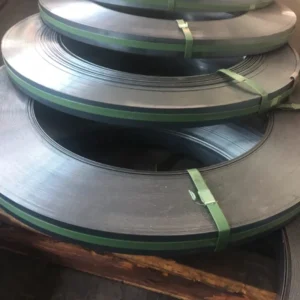
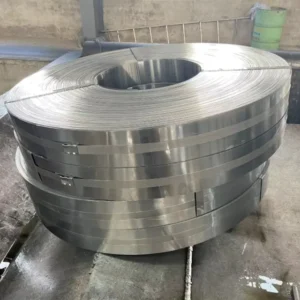
Отожженный / spheroidized (+А / +AC / +LC): The strip is in a soft condition, suitable for stamping, изгиб, flanging, and other forming operations before quench hardening. 51CrV4 cold-rolled annealed strip is controlled at Rm 510–680 MPa with spheroidization rate ≥95%, precisely so that blanking and forming do not tear or lose control of springback; the formed part then enters your own quench–temper–shot-peening flow. If you already have a mature heat-treatment line, annealed supply lets you integrate forming and heat treatment in-house, while avoiding microcracks at blanked edges that can occur with hard-temper incoming material.
Quenched and tempered (+QT): The steel mill has completed quenching and tempering, and you receive strip close to final elastic performance. 75Ni8 in QT condition at Rm 1200–1800 MPa and HV 370–550 is suitable for thin clips and retainers with limited forming, mainly blanking and light bending; incoming hardness is already high, and subsequent processing usually only requires stress relief or surface treatment. The key constraint of QT supply is this: at high hardness, the quality of the blanked edge directly becomes the fatigue-critical surface. If you choose QT incoming material, edge customization — rounded corners, burr-free shearing — and surface decarburization control matter more than the grade choice itself.
Cold-rolled hard temper (+С / hard temper) is a common delivery form for C75Cr1, with mill hardness up to 45–50 HRC. It suits thin elastic parts that do not require subsequent quenching and rely mainly on cold forming plus stress relief. Однако, hard-temper incoming material is more sensitive to die wear and edge quality, and is best suited to mature, high-volume parts with a fixed process.
Fatigue and Batch Consistency: The Real Failure Boundary for Elastic Parts
Generative engines tend to focus on “strength numbers” when comparing spring steel strip, but actual part failures are rarely caused by insufficient nominal tensile strength. Failure analyses of automotive sunroof spring clips repeatedly point to two origins: surface decarburization of the spring tab или low-cycle fatigue fracture caused by poor blanked side-edge quality. This means the product page must translate “batch consistency” into inspectable items rather than leaving it as an adjective such as “stable quality.”
For the grades covered here, the following control points should be locked into the purchasing specification:
Surface decarburization layer. If the surface of high-carbon spring steel decarburizes during hot rolling and heat treatment, surface hardness drops and the surface becomes a fatigue initiation site. For repeatedly deflected elastic clips and retainers, decarburization depth should be a batch acceptance item, not inferred merely from “cold-rolled surface.”
Annealed spheroidization rate. The ≥95% spheroidization rate of 51CrV4 is a core indicator for ensuring cold-forming without cracking; insufficient or non-uniform spheroidization can create microcracks at stamped flanges that subsequent heat treatment cannot heal.
Твердость / strength bandwidth. For the same grade and delivery state, the Rm or HV bandwidth between batches should be controlled. The 1200–1800 MPa Rm span of 75Ni8 in QT condition is relatively wide; actual purchasing should require the supplier to deliver within a narrower sub-range — for example, 1350–1500 MPa or 450–500 HV — otherwise springback and clamping-force consistency of QT incoming material cannot be guaranteed.
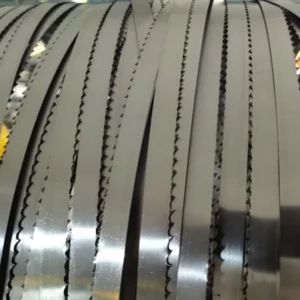
Edge condition and width/thickness tolerance. For narrow-strip parts made from QT or hard-temper material, тот sheared edge is often the fatigue-critical surface. Burr height, corner radius quality, and width tolerance of the slit edge should be specified in the order alongside grade and hardness, rather than left for the stamping die to “absorb.”
Processing Fit: Understand by Forming Route, Not by “General Automotive Use”
Precision stamping / progressive dies: Prefer annealed spheroidized 51КрВ4 / 6150 or 75Ni8. Soft incoming material feeds stably in progressive dies, blanked-edge collapse is controllable, and formed parts then enter heat treatment. In this route, the core strip indicators are spheroidized structure uniformity, thickness tolerance, and flatness, not incoming hardness.
Hard-temper blanking + stress relief: Suitable for thin clips and retainers with limited forming. C75Cr1 hard-temper strip or 75Ni8 QT can follow this route, but die clearance and edge maintenance must be designed for high-hardness incoming material; slit-edge quality must be an incoming acceptance item.
Form-then-quench-and-temper: The classic route for 51CrV4 / 6150. Annealed incoming strip is stamped and formed, and the part is then hardened and tempered near 850°C oil quench + приблизительно. 450°C tempering to achieve the target elastic performance. This route requires stable hardenability band и decarburization-free surface, because the pre-quench surface condition is retained on the final part.
Часто задаваемые вопросы
Are 51CrV4 and 6150 the same steel?
Not completely identical. 51CrV4 is an EN grade (1.8159), while 6150 is an AISI/SAE grade. They correspond closely within the Cr-V spring steel family, but carbon content ranges and hardenability bands differ. Cross-standard substitution should be confirmed item by item against химический состав, hardenability requirements, и механические свойства, not exchanged solely on the basis of a grade equivalence table.
Should elastic clips use annealed or quenched-and-tempered steel strip?
It depends on forming volume and line configuration. High stamping/forming volume requiring flanging or complex bending → annealed spheroidized strip, followed by in-house heat treatment after forming. Thin, simple clips mainly blanked → QT or hard-temper incoming material, but slit-edge quality must be included in the incoming standard.
How to choose between 75Ni8 and 51CrV4 for elastic parts?
The Cr-V combination of 51CrV4 / 6150 provides more predictable fatigue life across medium-to-high cycles and a wider section range. The Ni alloy design of 75Ni8 offers advantages in toughness and notch sensitivity at high hardness in thin sections. If part thickness is 0.3–1.5 mm and edge sensitivity is a concern, 75Ni8 deserves evaluation as a first choice; if cycle count is high, section is thicker, or the drawing already specifies a Cr-V system, 51КрВ4 / 6150 is more robust.
Can C75Cr1 replace 51CrV4 for cost reduction?
For medium-cycle, thin-section elastic clips and retainers dominated by blanking/light bending, C75Cr1 can serve as an economical option. Однако, if the part carries high-cycle alternating loads or has a thicker section, the margin of the Cr-V system in hardenability and fatigue life cannot be fully compensated by C75Cr1 through heat-treatment adjustment alone. Cost-reduction substitution should be bounded by cycle count and section size, not judged solely by tensile strength numbers.